Joe's Jottings

  • About Me
  • Writing….
  • The Birth of a Brand

    As some of you may know, I’m on the Board of the Hillsborough Forum, a group that works for the economic regeneration of the Hillsborough area of Sheffield, and also coordinates other activities in that area, such as ‘Yorkshire in Bloom’ and other community activities, such as Community Gardening.  I’m very proud of my involvement with HF – and certainly enjoy working with some wonderful people such as Wendy Wells.

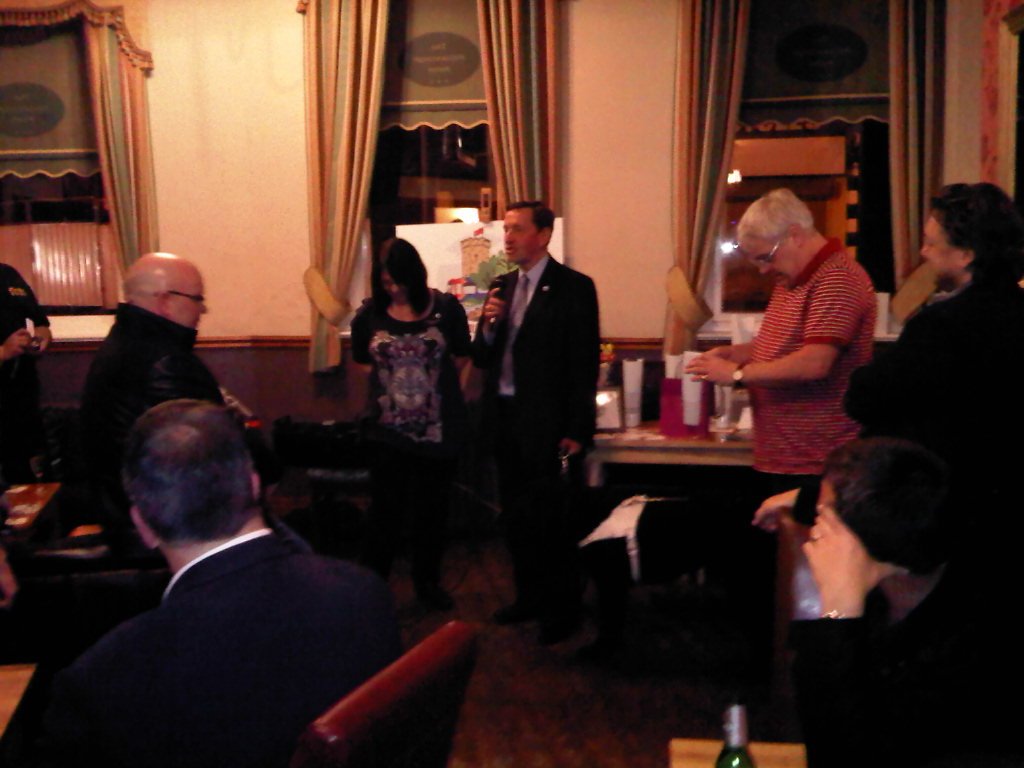
    Tonight we had an event to launch our ‘Made in Hillsborough’ brand – an attempt to provide a unique and easily identifiable brand for companies and businesses based in the area.  the brand was designed by local, highly skilled, Graphic Designer Emma Metcalfe and manages to encapsulate all the major aspects of Hillsborough – green spaces, soccer, the Barracks, the range of produce available in the area.  It’s so ‘hot off the press’ that the first time I saw the ‘full version’ of the logo was at this presentation, and it’s a smasher. 

    It’s partially visible in the background of the above photograph and on the right you can see a larger version of the logo in all it’s glory!  The launch took place in the Hillsborough Hotel, who provided us with excellent surroundings, a nice buffet and a very nice special brew for the occasion from their in-house Crown Brewery – Hillsborough Pale Ale.  Of which a fair amount was quaffed by all, including me.

    There was an excellent set of introductory talks from the Rt. Hon. David Blunkett MP, local author and historian Ron Clayton (Ron – if you’re reading this send me your web site address!!)  and Hillsborough Forum’s very own ‘member of the Queen’s Gang’, Wendy Wells MBE.  And then it was down to networking, brewery visiting, eating and drinking!  And a fine evening was had by all, with your correspondent finally strolling home through the drizzle at 11pm!

    We had excellent support from many Hillsborough businesses for raffle prizes and give-aways on the night including Picky Miss Sock Monsters, Imogen’s Imagintion (milinery / hats), Simpkin’s Sweets, Teddy Bear Maker and Funks Butchers.  On a personal level it was great to see old friends again, and make contact with Russell Cavanagh who runs NW Sheffield News Online.  My major social gaffe of the evening was not immediately recognising the very friendly folks from the Java Lounge coffee shop in Hillsborough – given the amount of coffee and cheesey crumpets they’ve served me in recent months that was a wee bit embarrassing! 

    But – thanks to all!!  Follow @Hills_Forum on Twitter, and if you want to help plug the brand, use the #MadeInHillsborough hashtag!

    March 26, 2010
  • Civil Partership ceremonies on religious premises….some contradiction in terms?

    Over the last decade or so, the number of times when New Labour has created legislation in what ‘the Simpsons’ would call ‘the American way’ – i.e. do a ‘half arsed job’ – has been legion.  There must be some sort of finishing school for NuLab legislators where they go to have that bit of the brain responsible for common sense somehow removed.  And now Lord Ali has kept up the tradition by tabling an amendment to the Equality Bill that allows civil partnership ceremonies on religious premises.  Note the juxtaposition of words there…civil…and religious.

    In a letter to The Times, Lord Carey, a former Archbishop of Canterbury, has expressed his concerns about this amendment.

    Now, I was of the impression that the reason civil partnerships existed was for people who could not or would not undertake a religious marriage (irrespective of religion) but still wanted to publicly commit themselves to each other.  Look what the direct.gov website has to say on the issue:

    “A civil marriage ceremony cannot have any religious content, but you may be able to arrange for individual touches such as non-religious music and readings to be added to the legal wording, and for the ceremony to be videoed. The register office where you intend to marry will be able to tell you more about the options available.

    A Civil Partnership is legally formed by the signing of the civil partnership schedule. Like a civil marriage, this is also non-religious, but couples who wish to arrange for a ceremony should discuss this with the registration officials.”

    Seems pretty straight forward there.  They even say ‘cannot have any religious content’.  With me so far?  Good.  Let’s take a moment to thing about religious buildings – and I’m going to include churches, mosques, chapels, synagogues and temples here.  Most religious buildings are built with certain tenets, based on the religion in question, in mind.  Ignoring the theological issues around whether the church refers to the building or the people who celebrate there, and focusing purely on the building itself, there are aspects of the construction and furnishing of most churches (and other religious buildings) that are symbolic – altars, crosses, positioning of certain fittings and furnishings, the orientation of a building within a plot of land – all can be highly symbolic, and hence ‘religious’.  So, to be strictly within the letter of the law, any ceremonies held would have to somehow remove the symbolism from the building.  Do we have to take away a cross because it might show up on a video, for example?

    We then have the whole raft of issues around desecration; if a Mosque were to be used, do we insist on all those entering the main part of the room to be barefoot to respect the building, or do we allow any footwear?  Same with clothing.  Or is it likely that this opening up of religious buildings would only apply to, for example, Christian denominations or faiths that do not insist on certain rules around footwear / clothing / etc.?

    And this applies whether the couple participating in the ceremony are heterosexual or homosexual; we have here a simple issue of a law being bought in as part of an ‘Equality Bill’ that will actually remove the rights of religious communities to indicate how their buildings are used by non-believers.  Hardly equal rites for them, is it?  Especially as in many religious communities the fabric of the buildings is maintained not by state or local government but by the religious group themselves.

    A religious building is for the celebration of religious events.  It’s not to provide a photogenic backdrop for people with no beliefs at all.  It isn’t to provide yet another football in the political battles around the rights of homosexuals vs heterosexuals in our communities.  By hanging this legislation of the Equality Bill, I’m afraid that it will end up putting some priests, Imans and vicars in a terrible position of being asked to go against their conscience or against the law in the name of equal rites – which don’t seem to apply very much to religious folks in these sorts of situations.  A vicar can refuse to marry people in a Church based on any number of reasons – divorce, where the people live, lack of obvious connection with the Church / parish.  These restrictions have been in place for centuries in some cases, and apply to everyone irrespective or sexuality, race, whatever who wish to use the Church.

    This law seeks to effectively de-consecrate religious buildings for a short period of time – it should be resisted.

    Now – here is where what I write will start getting contentious and I expect to be upsetting a few folks with what I say next. 

    It’s no secret that I am a religious man.  I like to think of myself as a fairly tolerant and reasonably non-judgemental fellow, but it increasingly seems to me that when our Government talks of tolerance and equality it usually means that religious folks are going to get it in the neck, and be expected to suspend some of our personal beliefs in how we conduct ourselves in our day to day lives.  If we’re now going to start being told who we can and can’t allow to use our own churches and holy places, then our rights are being eroded, and perhaps it’s time for some tolerance to be shown to us and our beliefs.

    March 24, 2010
  • Chrome – the prissy Maiden Aunt of browsers….

    I’m currently involved in developing a web application of moderate complexity using Ext to provide a ‘Web 2.0’ front end on a PHP/mySQL application.  We’ve endeavoured to make it work across a range of browsers – Firefox, IE, opera and Chrome.  And this is the blog article in which I vent my spleen about Chrome.

    Because, you see, there are some occasions when Chrome is an absolute bag of spanners that behaves in a manner that just beggars belief, and it worries me immensely.  If IE behaved in the same way that Chrome does under certain conditions then the Chrome / Google Fanbois would be lighting their torches and waving their pitchforks as they headed out towards Castle Microsoft.

    Giving Chrome it’s due, Chrome renders CSS well against standards, and is frequently faster than Firefox and IE in terms of delivering pages; where it does seem to be lacking is in it’s sensible handling of JavaScript. The general impression I’ve had over recent days with Chrome and JavaScript is that it’s incredibly picky about how it handles JavaScript that is less than perfectly formed – hence the ‘Maiden Aunt’ jibe.  It requires everything to be very right and proper.  I understand that any browser should be expected to deal with properly structured script, but in recent years I’ve found that the major browsers tend to behave in a pretty similar manner when processing JavaScript and tend to vary in behaviour when rendering CSS – hence the fact the some sites look different in IE than they do in Firefox or Chrome.

    But I’ve encountered some horrendous differences in the way in which Chrome on one side and Firefox/IE on the other handle JavaScript.  Chrome seems to be very ‘tight’ in it’s handling of two aspects in particular; white space and commented out code.  I hope that following comments might prove useful to anyone doing JavaScript development – particularly with libraries such as Ext.  Note that these issues don’t occur all teh time with Chrome, but have occurred often enough to give me problems.

    Watch the White Space

    Chrome seems particularly sensitive to white space in places where you wouldn’t expect it to be.  For example:

    • Avoid spaces following closing braces ( } )at the end of a js source file.
    • Avoid spaces around ‘=’ signs in assignments. 
    • Avoid blank lines within array definitions – don’t put any blank lines after an opening ‘[‘ before data.

    Watch the comment lines

    The // construct used to make a line in to a comment line needs to be handled with care with Chrome.  Don’t include it in any object or array definitions – whilst it works OK in IE, it can cause major problems in Chrome.

    Indications of problems

    If you’re lucky you may get a straight forward JavaScript error – in this case you will at least have an idea of what’s what.  If you’re unlucky you may end up with either an apparent ‘locking up’ of Chrome or a 500 Internal Error message from your Web server.  The ‘lock up’ will frequently clear after a few minutes – the browser seems to be waiting for a timeout to take place.  When the errors do take place, I’ve found that the loading of pages featuring JavaScript errors is terminated – it can give the impression that a back end PHP or ASP.NET script has failed rather than client side script.

    In summary, just be aware that Chrome may not be as well behaved as one would expect.

    And that’s my whine for the day over!

    March 24, 2010
  • I sometimes wonder….

    As some of you will know, I’m what’s best described as an (occasionally) practising Christian.  Just to get the joke out of the way early, I’ll keep practising and one day I hope to get it right!  Yesterday I attended a Christening in a different Church to my usual one, and the sermon offered was about the topic of expectation; funnily enough, over the last 24 hours I found myself pondering a few issues around the topic of expectation – what I expected form others, and what others expected from me.

    The funny thing is that this isn’t the first time that this has happened to me.  Before I became a ‘regular’ attender at Church, I’d sometimes go on a whim and was quite surprised at how often the sermon or a reading in Church would provide me with insights in to whatever was uppermost in my mind at that time.  Of course, I’m aware that there are any number of explanations for this sort of thing.  The first is that I remember only the times when there was a relationship between my state of mind / concerns and the sermon given on a particular day.  A second explanation is that I read more in to the sermon or reading that is actually warranted.  And there are probably more….

    But…it sometimes makes me wonder.

    Whether coincidence, causality or synchronicity I do find the experience useful, and in many ways that’s all that counts.  I get inspiration, guidance and intellectual provocation from what I hear at Church, as well as an affirmation of my faith.  I sometimes wonder if these ‘coincidences’ are actually some sort of answer to prayers that I’ve not said out loud – they are often so very relevant and provide me with inspiration and insight to get stuff done. 

    As an aside, I just heard the following line of dialogue from the TV show ‘FlashForward’ that ‘What some people see as coincidence is actually God at work’. 

    Daft as it may sound, I think that’s a great point to finish this post.

    March 22, 2010
  • All your personal info belongs to…some web site or other?

    This is an interesting little article about a new product from Mozilla Labs for Firefox – it allows you to grab tour personal contact data from various web services and sources, and then keep it in a repository from where you can decide exactly what to make available to OTHER web services and sites.   The data is stored and indexed locally – as @timoreilly tweeted – “I like the idea of a smarter client-side address book, so my social data doesn’t end up belonging to someone else. ”

    And so do I.

    I have a large contact list in Outlook on my PC which definitely goes nowhere near any online web service.  In a similar way, 95% of people I deal with on Facebook I deal with purely on Facebook; same with twitter and any Internet Forums I belong to.  If  Twitter and Facebook disappeared overnight, I’d lose access to quite a few contacts I have in those two ‘depositories’ of data, but some folks on there that I would DEFINITELY miss in the event of Social Networking meltdown I’ve got alternative means of contact for – usually e-mail addresses, occasionally phone numbers.  As for e-mail, I tend to use good old fashioned ‘Mail Client’ software – Outlook again, I’m afraid! – and rarely use web mail.

    I guess the bottom line is that I don’t really trust any server outside of my direct control when it comes to storing my personal data.  I wouldn’t feel 100% safe with having all of my contacts lists on the servers of someone like Microsoft or Google for a couple of reasons:

    • Your access to your contacts is gone if they have connectivity issues or a server goes.
    • Your contacts are open to exploitation from hackers / spammers.
    • Your contacts contribute to the ‘database of intentions’ – if your contacts have accounts with people like Google or Amazon using the email address in your list, it’s potentially possible for their interests to be used to target ‘social advertising’ at you when you use your email address to access a site.

    This is without starting to worry about the issues surrounding storing my content on other people’s servers.  No, I’m much happier to keep my central list of contacts on my PC.  I can back it up, it’s always there when I have access to my PC, if I want to put it on another machine it’s just a case of copying it over.

    The Mozilla application looks useful in terms of getting backups of such data – which is great – but I’m still going to be terribly inefficient and keep my contacts where I know what’s happening to ’em!

    March 21, 2010
  • Facebook user hypocrisy or common sense?

    I came across this article in my Twitstream today about how young professionals are changing their name and doing other things to camoflage their presence on Facebook and other social networking sites in order to cover their tracks from potential employers or head hunters who might find some aspects of their personalities or character less employable than might be desired.

    For a while now there has been a suggestion that people should run separate Facebook accounts for their ‘private’ life and their ‘professional’ life, and make sure that all the partying, socialising, membership of bizarre societies, etc. ends up in the ‘private’ account with the privacy restrictions applied to restrict access to friends only, and ideally with a suitable disguised name.  The suggestions made in the article above have included people setting up accounts under their middle names for one account, for example.

    At first glance it seems to be a rather sensible idea; but recently I’ve started wondering whether the establishment of public and private personas in this way is not so much common sense as hypocrisy or even dishonesty.  Let me elaborate…

    Many years ago – in the days before Facebook, MySpace, Twitter, what have you, the general rule of thumb was to believe that anything you posted on the Internet would most likely come back to haunt you at some point.  this is more the case today.  My personal way of looking at this is to imagine anything you post on a public forum, blog, Facebook or Twitter being read out to your mother, bank manager, boss and spiritual leader on a busy afternoon in the middle of the local High Street. 🙂 

    So at first glance it might make sense to get all the less reputable stuff tucked away somewhere safe….

    But hang on a minute – it’s still you!  If your politics, religion or sexuality is such that you fear that they may put potential employers off of recruiting you, then perhaps you need to think about whether you would really want to work for such a company, and whether you would be happy there.  Getting recruited in to an organisation where you have already hidden some core aspects of your personality is not the best start to a working relationship; let’s face it, it will turn up at some point in your career!  And if it’s some aspect of your behaviour, then again – it’s still you.  We all have occasions when we get a little worse for wear on drink, and get photographed in that state, and we all make the occasional ‘off colour’ jokes.  As soon as you start hiding these things away from people who’re wanting to employ you then you’re basically selling a false personality to your recruiters – again, dishonest.  And if you’re dumb enough to post up details of serious indiscretions – drugs use, minor crime, etc. – then to be honest you’re an idiot who deserves what you get.

    Of course, it’s not always that easy; some employers are so ‘straight up’ that any deviation from the straight and narrow is regarded as evidence of gross moral turpitude.  And you can’t always determine what photographs your friends take and display – I’ve spoken about this elsewhere on this blog – but then again, there is the old saying about ‘A man is judged by the company he keeps.’

    My own advice, for what it’s worth?  Don’t bother having dual Facebook accounts; just stick with the one, set up good privacy settings and be civilised with what you post to it.  Anything else is hypocrisy.

    March 20, 2010
  • New Media, Old Manners

    This post is based on some comments I made on another blog recently – dealing with the question of whether using Social media turns us in to rude bumpkins.  Whilst it’s true that the decision to participate or not in all this Tweeting and Facebooking is in our own hands, the amount of general rudeness that this sort of all pervasive social media generates is astonishing.  I appreciate that I come from an older generation who had very different ideas of what behaviours are acceptable, so I hope you’ll pardon me if I appear to be something of a dinosaur!

    Here are a  couple of ‘old style’ rules of thumb that I was taught years ago about the etiquette of using technology that I still use today.

    • If you have a visitor, hold the phone calls.  If a call gets through, ask briefly if it’s important, as you have a guest.  Then if it proves not to be important, arrange to call the caller back later.  If you’re responsible for your own calls, let an answering machine take it. 
    • If you are in a conversation on the phone, don’t multi-task and email at the same time.  No matter how good you think you are at multi-tasking, the person on the other end of the phone will know you’re doing something else.
    • If someone asks you for the contact details of a third party, then contact the third party first and ask, or mail that person on behalf of the person asking with THEIR details.  Don’t give the personal details of someone else away without asking.

    Social Media users often breach the equivalents of these old style social guidelines.  We Tweet when talking to people, share personal information like locations and photographs of third parties with people who may be total strangers.  We forget that the people we’re WITH are more important than the often relatively anonymous folks in our extended electronic network.  I have to say that I find it strange to be sitting in the pub with people and have half the group tweeting or Facebooking – it’s a habit that I’ve started acquiring a little as well.  I find it equally weird to be in courses or seminars – or presentations – and find people Tweeting – even if they’re encouraged to do so!  I just find it hard to believe that people can be paying attention to what’s being said whilst using social media.

    I have to wonder how much of the use of Social Media by some people is akin to the mobile phone using buffoon portrayed by comedia Dom Jolly in which a guy is bustling along holding a gigantic mobile phone and is yelling in to it – it’s an ego-prop rather than a communications tool. 

    Do you REALLY need the world and their dog to know you’re arriving at your hotel?  Or is it all about ego?

    March 19, 2010
  • Facebook and the panic button….

    Since the recent case in which a teenage girl was groomed and murdered by a paedophile via the Facebook site, there has been a lot of pressure from the UK Government for Facebook to put a ‘Panic Button’ style link on the site – a move supported by the CEOP organisation.  Facebook have commented that they have no objection in principle to making it easier to report abuse on the site, but that they feel that the CEOP supported option is not necessarily the best way.

    Facebook are far from perfect in the way that they treat their users; I think all of us who use the site would have our own grumbles about privacy and the attitude of Facebook as a whole towards individual users now that they’ve got big.  But to be honest I think I would rather central Government stayed out of issues like this – especially New Labour, who seem to have spent the last decade dismantling our civil liberties bit by bit.  For a previous broader comment on this issue, I direct you to this item from a year ago, in which author Phillip Pullman commented on the behaviour of New Labour.

    Since then we’ve had the Digital Economy Bill – even without the Lib Dem Peers’ Amendments it was a pretty poor piece of legislation.  With the amendments it offers a wonderful means of stifling debate by simply shutting down access to any site that breaches copyright.  Under the Bill, as it stands, and if it were strictly applied, YouTube could be blocked to UK ISPs because of material that breaches copyright. 

    Part of the problem with New Labour is their amazing ability to put together piss-poor legislation on a ‘knee jerk’ basis.  A lone gun nut leads to a total handgun ban – which doesn’t affect criminals as they tend to disobey the law anyway.   Despite massive increases in the legislation aimed at child protection, the very basic laws that were there all along fail to be implemented and children keep getting killed.  And there are many more examples.  One interpretation of this repeated series of cock-ups is that they’re just incompetent; my own interpretation is that New Labour are just incredibly keen on reducing our civil liberties as much as they can to have a nicely compliant and obedient citizenry.

    The issue for me here is not just the Facebook reporting mechanism; I’m afraid I regard that as something of a ‘thin end of the wedge’, by which Government could influence and impact the policies of web sites not even based in Britain.  It’s not far from that sort of thing to the  censorship policies adopted by China and, more recently, but to a lesser degree, Australia.  Protesting about this sort of Government activity, which initially starts with child protection, is a little bit like trying to answer the question ‘Have you stopped beating your wife?’ in a way that doesn’t make you guilty.  But given this Governments record on civil liberties I’m afraid I do not and cannot trust them. 

    As  Rousseau said “Free people, remember this maxim: we may acquire liberty, but it is never recovered if it is once lost. ”

    And we’re losing it bit by bit.

    March 18, 2010
  • Caprica 90210

    I am an enormous fan of the re-visioning of ‘Battlestar Galactica’ – good story and plot, good characters, nice combination of high tech and retro gadgets (loved the old style telephone handset that was used in the command centre).  Combine that with excellent soundtrack – just the best TV science fiction in recent years.  When I heard that a ‘prequel’ of BSG was in the works, I was a little bit concerned, but hopeful – same folks involved, should be worth watching.  And so I watched the pilot of Caprica with interest….

    The following will help understand this post if you’ve not watched Caprica.  Daniel Graystons, father of Zoe, has a company involve din military robotics and AI.  They’ve made something called a Cylon, which needs an electronic brain called an MCP to work.  Joseph Adama, a top lawyer, has a daughter, Tamara, who was killed in a terrorist attack along with Zoe.  Both girls had ‘avatars’ in a VR game, and these avatars have retained form after their death.  Zoe ends up in the electronic brain of the prototype Cylon.  Tamara ends up left in the VR systems.

    With me so far?  Where the frack did it all go wrong?

    Don’t get me wrong, it isn’t all doom and gloom in Caprica, (list of episodes and plot here) and at one level that makes it worse – every now and again stuff starts happening and you’re at the stage of ‘Oh yeah, here we go, they’re gonna start turning out Cylons in a production facility, and Zoe – that teenage lass who’s consciousness is in the prototype – will….er…..do something…but hey, we’re looking at some serious tin men whupping Colonial Marine action!’  But then we cut back to a frackin’ boarding school or a VR representation of Dawson’s Creek.

    And that’s the problem.  There is simply too much attention being paid to teenagers in this whole saga.  And that’s the flaw.  Last night we had Zoe going on a virtual reality date with the teenager who is helping her father work out why the ‘brain’ of the one working prototype works and others don’t.  The two teenagers end up with a suggestion that may point to the problem.  Back in the lab, old man Graystone is told this by his teenage assistant and it’s as if he’d never thought of it.  Hello?  This guy is the Stephen Hawking of robotics and AI.  His company make the holographic interfaces that people use to go in to immersive virtual realities in Caprica.  He’s not Homer J Simpson, for crying out loud!

    Elsewhere, the head of the other family involved in the saga, Joseph Adama, is swanning around in a VR ‘game’ called ‘New Cap City’ trying to find the avatar of Tamara.  It works well, some shoot ’em up and folks with the same tailor as Neo and Trinity from ‘The Matrix’ – I’m hopeful that this will go places.  The religious / spiritual angle – monotheism emerging in a polytheistic culture – is really interesting as well.

    But then we get the bloody teenagers again and I weep in to my tea.

    Come on guys – I can see that you want to reach the teen demographic, but don’t forget the rest of us.

    March 17, 2010
  • Shock Doctrine comes to Haiti?

    A couple of years ago Naomi Klein wrote a fascinating – and scary – book called ‘Shock Doctrine’  in which she presented the thesis that what we now call ‘free market capitalism’ – that form of capitalism that started with the activities of the Chicago School of Economists in the late 60s and 70s – came to it’s successful position in our world by a combination of military and political interventions that were almost acts of war.  She posited that various regimes – starting with the Pinochet regime in Chile in the 1970s – used the dislocations in society caused by coups, war and even natural disasters to bring in to being a form of free market economy that exploits the vast majority of people and gives certain companies and individuals vast wealth on the back of Government policies.

    Recent examples have included the way in which beaches areas were sold off for tourist hotels after the Asian Tsunami wiped out fishing villages, the way in which New Orleans was totally socially re-engineered after Hurricane Katrina and the way in which companies like Blackwater and Haliburton have made vast profits form the war-created crises in Afghanistan and Iraq.

    So, we shouldn’t be surprised, despite the removal of President Bush,  to see companies moving in to Haiti to exploit and socially engineer the country after the recent earthquake.   It’s a good situation for the purveyors of ‘disaster capitalism’- a sort of peacetime ‘shock and awe’ – which can make use of natural disasters that dislocate normal society.  The Haiti earthquake’s magnitude, combined with the nature of the country, gave a fertile ground for these people to operate in.  Let’s just take a look at the situation there.

    • People are still without proper shelter; nothing like forcing people to live in squalor to break their will.
    •  Just a 100 miles north of the devastated capital city, cruise ships are docking at privately run resorts.
    • The Heritage Foundation – an advocate group for disaster capitalism – pulled the following quote shortly after the ‘quake: “In addition to providing immediate humanitarian assistance, the U.S. response to the tragic earthquake in Haiti earthquake offers opportunities to re-shape Haiti’s long-dysfunctional government and economy as well as to improve the public image of the United States in the region.”  Even their existing material tries to play up the ‘communist threat’ angle – pretty pathetic.
    • The first loan given to Haiti by the IMF after the quake allegedly came with various strings attached – increasing prices of power, etc. – that is typical of the approach that the IMF have previously taken when they wanted to bring about neoliberal political change in a country as a condition for getting financial help.

    In other words, despite the attention being paid to Haiti at the moment, and the demise of the Bush Government, there is still potential for disaster capitalism to be used to radically restructure Haiti in all the wrong ways.  And it’s worth remembering that some of the larger companies who typically profiteer from these situations will only start showing up when rebuilding starts – i.e. when there’s money to be made.

    Hopefully if they realise the rest of the world is keeping an eye on things they’ll be put off – a bit like lobbing rocks at a dog grubbing around your dustbin.  If you want to find out more, take a look at the following:

    http://www.facebook.com/group.php?gid=292737727221

    http://twitter.com/nohaitishock

    Say ‘No’ to Disaster Capitalism – you never know where it might show up next.  Time to stop the bastards in their tracks.

    March 16, 2010
←Previous Page
1 … 18 19 20 21 22 … 39
Next Page→

Twenty Twenty-Five Legal Pad

Designed with WordPress