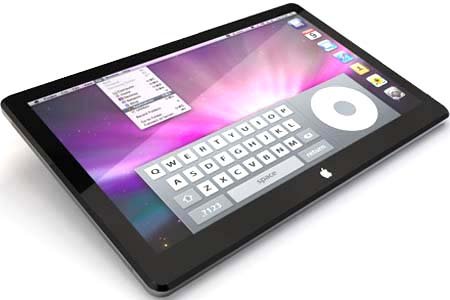
Well, the fuss over the launch of the iPad has died down somewhat – it wasn’t the Second Coming or the Rapture, the world didn’t suddenly turn Rainbow coloured (not for me. anyway) and the Apple Fans have gone quiet. So, perhaps it’s time to take a few minutes to think about what the iPad might mean in the future. This is an interesting viewpoint – that the iPad could be the first step on the road to the computer as a true ‘appliance’.
In some ways, this might not be a bad thing – after all, it’s the way that all technology has tended to go over the years. Take for example radio – the first radio receivers required the operators to be reasonably knowledgeable about the equipment, and in some cases be able to build and maintain their own equipment. Radios required large outside aerials, and I clearly remember a ‘Home Maintenance’ book that my mum had that dated from the 1920s that had great amounts of information about how to service your wireless were it to go wrong. By the 1930s they were more self contained ‘black boxes’ – OK, self contained walnut wood boxes – and by the time we hit the 1970s little radios were being given away as children’s toys. We’re moving along that path with computers; when home computers first became available then you were expected to want to write some of your own programs or even build the machine, then published software came along, then we have the time we’re in now when very few people write their own software at all.
But the thing is with contemporary computers is that you can still write your own software if you wish to; you can go out, buy a copy of VB.NET, download Python or PHP or Java and with some application write your own software. And if your computer doesn’t support media you want to view or listen to, you can just get a piece of software installed that will do the trick. And if you want it to do something totally new, you can again find an application somewhere, or write your own, or commission someone else to write it for you – all without fear or favour.
If computers follow the logical progression, then we could expect to see them move on to a stage of development where they are pretty much ‘closed units’ – the old joke of ‘no user serviceable parts’ will be very applicable. Think of the computer of tomorrow as being a little like your smartphone or a digital TV with Satellite TV and a DVD recorder built in; there’s content for you to view, you can save it, there may be services to buy, but you’re not going to be able to add functionality to it by producing your own code or content to run on it.
In other words, surprisingly like an iPad. And some analysts have noted that the apparent lack of expandability of the iPad might not be a design omission, but might actually be a deliberate design policy.
Producing computers that are simply glorified media players has a number of advantages for many parts of the hardware and content industries. To start with, if you can totally control the hardware and software environment then you can restrict your support calls; many software houses that produce applications for Windows have to have reasonable support functions in their companies because whilst their software runs on Windows, each PC running Windows is to a great degree unique, and therefore offers a near unique environment on which the application runs.
A further point is that once you stop people from being able to put their own software on these machines, then you also prevent a lot of the issues of illicit copying. By controlling the platform you can control the way in which the platform handles content that might be protected by some sort of Digital Rights Management software. Indeed, it’s not too difficult to imagine a situation in which the functionality available on the unit can be remotely enabled and disabled based on the payment of licenses or rental fees – similar to the way in which satellite TV receivers can be activated or de-activated remotely.
The Appliance Computer has a lot to offer manufacturers and content providers; it locks users in; it protects content; it makes the equipment more reliable. But it also eats away at the very foundations of what has made so many software applications possible – the ability for anyone to write their own software.
Don’t let Appliance Computing remove the freedom to compute.
Many years ago there was a joke in techy circles that likened Microsoft to the Star Trek aliens ‘The Borg’. It appeared at the time (mid 1990s) that Microosft were indeed determined to assimilate everything they encountered and absorb the technology of other companies in to their own. Well, like the Borg in Trek, Microsoft finally found that they couldn’t assimilate everything.
An item caught my attention recently
I’m not overly paranoid about people knowing where I’ve been on the Internet; I’m aware that it’s pretty easy for a website to feed your browser ‘tracking cookies’ that can be used for marketing and advertising purposes, and these can then be picked up on other sites, thus providing a path of footsteps that you have followed online.