Joe's Jottings

  • About Me
  • Writing….
  • Bust the brainy kids – you know it makes sense!

    Although this little gem of a story happened in the US, I have no doubt that given a few more months it’s likely to happen here.  Well…I don’t know…at least the Yanks encourage science and technology enough to actually organise things like science fairs…  However, back to the story.  Smart kid builds a motion detector from some electronic bits and puts it in a bottle.  Bottle is picked up, sensor triggers.  Cool.  Good future ahead of a bright kid like that – some technical education, quite possible a Gates or Jobs of the next generation…

    That would be what I would be saying were I not living in Stupid World, where the kid’s teacher called in the FBI and the bomb squad, put the whole place on lockdown and suggested the kid and his parents needed counselling.  Hello?  WHO needs counselling?  If this is the standard of management that is present in US schools then God help them.  At a time when we need to encourage bright thinkers and hopefully generate a new generation of technologists, scientists and educators that can get us out of our current hole, this dimwit sets in motion a series of events that will probably encourage the kid to never show initiative again and stick to playing X-Box games and watching TV until he can graduate to drinking beer, playing X-Box games and watching TV.

    Tragic.

    I was like this as a kid – fortunately with one exception I had support from my teachers, and always had support (or at least quiet acceptance!) from parents, aunts and uncles and in latter years my wife!  I built radios, movement sensors and any number of electronic gadgets.  I accidentally jammed local TV sets whilst working on a radio control gadget, generated more smells than I could shake a stick at and learnt more about science and technology in my own time than I probably did at school.

    Today, with what appears to be terror hysteria in the US and ‘Elf and Safety’ silliness in the UK it’s increasingly difficult for proper ‘hands on’ science education to be done.  We really should be working hard to encourage this sort of practical approach to science and technology, both in in schools, colleges and via technical hobbies such as the practical approach fostered by amateur radio, robotics, astronomy, etc.   Unfortunately the UK does not seem to be doing this through educational policy.   This item from a few years ago points out exactly what is wrong with modern science education in the UK – it’s too wishy-washy and based around social awareness and ‘scientific literacy’ whilst moving away from teaching separate science subjects and encouraging education in the ‘basics’ of science – the scientific method, practical lab work, etc.

    Whilst the literacy and social awareness issues are important, it’s critical that they are secondary  to a scientific education that prepares our future scientists and technologists by educating them in basic, practical science and technology, so that they can approach the more advanced stuff from a position of having firm foundations.  I hear all the voices saying that it’s important to engage students with science; but there is absolutely no point at all in engaging students in a watered down, multi-media based representation of some of the most practical and critically important subjects around.

    January 17, 2010
  • Myleene Klass, ‘PC’ and PCs

    414px-Myleene_Klass_--_Greatest_Britons - From WikipaediaThis is a long story in celebrity terms…but stay with me.  It’s one of those tales where we can’t tell who’s version of what happened is actually the right one – so many versions of what happened it’s like a Celebrity Rashomon! It starts some weeks ago when Myleene Klass commented that immigrants to the UK should actually learn to speak English in order to help them assimilate better.  This is such a common sense suggestion that it actually beggars belief that it’s worth reporting on.  Klass’s own family background suggests that this is a good move; her mother is from the Philippines and Klass herself has clearly managed to fit in to the UK.  She also dared to make a few comments about issues that are frequently referred to as being ‘politically correct’ – and that’s probably the point at which she started showing on the liberal / media establishment radar as someone to keep a weather-eye on…

    Time moves on – a few weeks later, 2 local teenagers trespassed on Klass’s property, apparently attempting to break in to her garden shed.  She was alone in the house with her young child, and did what most of us would have done – told the little scrotes to go away, unfortunately for her whilst holding or waving a kitchen knife.  From within her house, through the window. 

    Here’s where it gets interesting; the police who arrived allegedly gave her the telling off for waving the knife, which was referred to as an offensive weapon.  The police later denied this, but the media storm was unleashed with folks coming down mainly on her side of the argument.  The police behaviour was reported by Klass’s spokesman.  Life now gets complicated; it appears from a report in The Guardian that Klass’s agent and Klass herself both called the Police, and that the only comment made by the police (according to the Police) was that Klass should have contacted them sooner.

    If you take a look at the comments following the Guardian story, it’s pointed out how it’s rare for The Guardian to take the Police side of a story at face value.  There were also a few comments from the Grauniad readers that, to be honest, were snobbish.  Comments on the ‘classiness’ of someone’s name shouldn’t reflect on how the story is reported, after all.  Complete with ‘Sun’ style photo mock-up of Ms Klass wielding a knife.  hello?  I assume this is ‘ironic’.  It just appears to me that the Guardian writer was using the trespass issue to take a swipe at someone for daring to criticise political correctness, and that a lot of ‘liberal’ readers of the Gruadian found a useful ‘two minute hate’ topic for the day.   Can we expect the same standard of reporting from the Ruardinag when one of it’s favourite (and oh so politically correct) luvvies hits the news like this?

    No?  Why am I not surprised.  There seems to be a sequence of events here that indicates one of three things to me;total coincidence,  incompetence in the way that the story has been handled by media, police and Ms Klass’s PR people, or a non-too subtle attempt by the current establishment to slap a celebrity for saying the wrong thing.  A warning that although you’re a celeb, say the wrong thing and we can still swat you like a fly.

    In other words, coincidence, cock-up or conspiracy.  You choose.

    January 16, 2010
  • Google does the right thing (for Google, that is)

    googlesignFor a long time I’ve taken the mickey out of Google’s famous slogan ‘Do No Evil’.  I mean, most companies and individuals go through life with their ethical and moral compass intact and manage to perform this simple piece of behavioural calculus every day of their lives.  To me, it takes a particularly arrogant bunch of people to make this slogan a selling point.  And it leaves you open to a lot of pot shots form people like me when you get caught with, figuratively speaking, your hand in the cookie jar.  And I know the irony of my position, being a Google user.  Please, Microsoft, get Bing sorted!

    And so it has been for a while with Google and the People’s Republic of China.  Google’s presence in China – Google.cn – was only sanctioned by the Chinese Government if the search results were modified (after all, censored is such an evilword) so as to suit the political world view of the PRC.  So a search on ‘Tiananmen Square’ might return lots of touristy stuff but certainly wouldn’t bring back stories about student protests, tanks crushing demonstrators, etc.  Google’s stand on this always seemed to be rather against their loudly stated intention to ‘Do No Evil’, but in this case it was pretty clear to everyone except those who’d imbibed of the springs at Mountain View that Google were supping with the Devil with a long spoon.

    Until this week.  This week Google announced they were re-considering their positin in the PRC after the company had detected what it described as “a highly sophisticated and targeted attack on our corporate infrastructure”in efforts to get in to the Gmail accounts of Chinese political activists.  This is almost certainly Google speak for “We know the PRC Government is behind this but can’t provie it / don’t want to say it in public’.  As a result, Google have stated:

    “over the next few weeks we will be discussing with the Chinese government the basis on which we could operate an unfiltered search engine within the law”.

    which at first glance seems pretty brave of Google – looks like they might be following through on the ‘Do No Evil’ stuff and are facing up, toe to toe, to the creators of the Great E-Wall of China.  It would be nice to think that Google’s ethical sense has finally determined that by running the filtered service in China they’re actually compromising their own integrity and also supporting a totalitarian regime.

    However, I think it’s most likely that Google will use this set of events as an excuse to get out of China altogether.  Why?  Google are second string in China; the locally developed search engine Baidu has largest market share, with Google apparently being most popular for technical stuff.  Google are losing face by their inability to get to the top of the tree in China, even after compromising their integrity.  In the West, Google are losing the lustre of ‘Do No Evil’ – in some quarters they’ve overtaken Microsoft as the Corporation you love to hate – certainly for me they’re a larger threat to my personal privacy than Microsoft have ever been in the whole history of that  software house.

    No, Google will pull out of China, or seriously reduce it’s exposure there, not for ethical reasons, but because it suits Google’s market strategy.  They need to save face out there, and regain some of the moral high ground at home.  This latest Chinese exploit will give them the excuse they need to exit and try and maintain that it’s all ethics, when it’s actually all market.

    For Google’s deal with the Chinese Devil, the spoon they supped with just wasn’t long enough.

    January 15, 2010
  • Enough toys for the boys (and girls)?

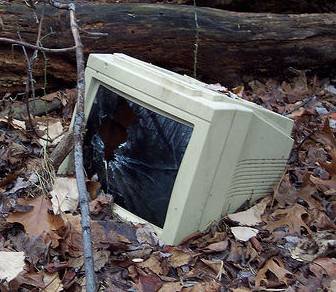
    broken-monitorI’ll be honest; I’m rarely rising the bleeding edge of technology.  Despite being professionally involved in IT and electronics since 1982, it’s safe to say that I’m not one of the guys who gets calls to become an ‘early adopter’ of some thrilling piece of technology that I can’t live without.  I use what I need to use to get my professional job done, and then in my personal life I tend to be a couple of years behind the edge.  After all, that gives folks ample time to find the bugs and get them sorted.  This saves me from tearing out what’s left of my hair. 🙂

    It also means that occasionally whole generations of technology pass me by whilst I happily manage with what I have.  This can occasionally be embarrassing – after many years dealing with the jokes about my ‘steam powered’ cell phone, 2009 was the year I caught up and got a Blackberry, and realised quickly that I’d been missing something that would have made my life easier.

    However, the last few years have seen me wondering what the heck’s happening on more than one occasion.  We’re encouraged to go DVD, then comes Blue-Ray.  We’re encouraged to look towards digital TV, then High Definition, and now 3D TV.  On radio we have DAB – this is probably the worst of the lot as in many cases DAB reception is significantly worse than conventional Band 2 FM radio.  The Internet bandwidth required to use up to date web sites seems to be ever increasing, and the hardware required to run cutting edge games seems to get more complex each year.  I’ve begun to think that perhaps it’s time to try and break out of this continuous consumption loop and maybe, just maybe, stop for a year or two.  I was further reinforced in this view by this article in The Guardian newspaper.

    The bottom line is that we know the ecosystem of the planet is increasingly fragile.  We also know that some of the industries with significant impact in terms of raw materials, production of components and disposal of waste and ‘outdated’ equipment is consumer electronics.  The companies producing the endless churn of new ‘must have’ products in order to keep their markets buoyant spout appropriately ‘green’ corporate messages but they are simply hypocritical efforts to gloss over the impact they have on the world. 

    Some may say that a world without new generations of phones and TVs every year is inconceivable, that progress is essential.  But is it?  Can we afford to carry on producing gadgets and equipment that is incredibly difficult to recycle, that swallows up disposable income, generates landfill, poisons the environment and uses up irreplaceable resources?  Especially when there is older technology around that meets the same needs but maybe not in 3d, maybe not with high resolution. 

    In a world that is increasingly suffering major ecological and sociological shocks, is it acceptable for large corporations to continue to encourage us to amuse ourselves in order to ignore the big issues? 

     Or maybe that’s the whole idea that we amuse ourselves to death?

    January 14, 2010
  • When Twitter gets like TV – lots of repeats!

    twitter-logoAs some of you may know, I’m a newbie at Twitter.  indeed, my first efforts were not impressive, I stopped, then re-joined with better results.  My saga and comments are briefly recorded in these two blogposts, here and here.  I’m now getting in to an almost regular Tweeting habit, though I’m still a consumer rather than producer of Tweets, and perhaps it’s my own way of using Twitter that gave rise to this post.

    The other day I was browsing my Tweets (I use Twhirl most of the time, btw – not bad at all, though I’m also looking at Tweetdeck) and I saw a Tweet that made me do a double take, as I was convinced that I’d seen the same Tweet, even down to the wording used, sometime previously that day.  It was a link to an article somewhere, and I remembered it because I’d read the linked article.  I did what I always do in these circumstances, assume that either Twitter or Twhirl had had some sort of brainstorm.  But no – the timestamp on the Tweet was a few minutes old, and other new tweets were coming in thick and fast.

    And then it struck me – the same tweets were being sent a couple of hours apart by the same user – sort of like the rolling news on Sky or CNN.  Sky promise all the news in 15 minutes, every 15 minutes, and some people are obviously doing something similar on Twitter. 

    Now don’t get me wrong – there is a time and a place (and a frequency) for repeat Tweets.  I’ve seen it used most effectively when advertising events, seeking urgent help, etc.  After all, the very ephemeral nature of Twitter means that on a moderately active Tweetstream a post will soon ‘fall off’ the bottom, so to say, and unless the user is monitoring reasonably actively the content will be missed.   But what works for ‘time critical’ stuff like up and coming events, urgent requests for help, etc. doesn’t really work for uplifting quotes, re-tweets of news items, etc.  It strikes me as being a bit like the approach taken by children when they want to get adult attention of repeating their request for sweets, biscuits, new toy, whatever every few minutes until the relevant adult either gives in or gives them a thick ear.

    And so it is that I’m seriously thinking of giving a few folks I follow the Twitter equivalent of a ‘thick ear’ by stopping following them.  I honestly don’t see the point of Twitter content such as aphorisms being repeated every couple of hours.  To take the TV analogy further, as well as being like rolling news it’s also like the ‘+1’ channels that transmit the same content as another channel, just 1 hour behind.

    In many ways, Twitter is like radio or TV broadcasting; unlike most digital content it is ephemeral and dynamic, and moves along a timeline – just like broadcast radio and television.  Maybe we ‘content providers’ for this new media need to bear this in mind and lay off the un-necessary repeats.

    January 13, 2010
  • The pleasure of the period-piece detective

    poirot-suchetI think my interest in what might be called ‘period piece detectives’ started many years ago, when I watched the big screen version of ‘Death on the Nile’ featuring the wonderful Peter Ustinov as Hercule Poirot.  I stunned my wife (and myself) by actually solving the murder pretty early on.  Since then, I’ve been rather a sucker for TV series such as Sherlock Holmes, Poirot, Miss Marple, Inspector Alleyn – those wonderful amateur sleuths (OK…Alleyn was a policeman but very much one of this crowd!) who seemed to outfox what Holmes would call ‘the official constabulary’ whilst inhabiting their particular period of history. 

    And that’s where part of the attraction lies for me – the settings as much as the detection work.  If we leave Holmes out for this article – after all, the fellow is such a phenomenon that he deserves his own blog item at the very least – these detectives all work in the late 20s through to the early 50s.  In his excellent essay ‘Boy’s Weeklies’, in which he discussed the popular boy’s comics of his day, George Orwell wrote about the atmosphere used for some of the ‘School Stories’ in these magazines:

    “…There is a cosy fire in the study, and outside the wind is whistling. The ivy clusters thickly round the old grey stones. The King is on his throne and the pound is worth a pound….Everything is safe, solid and unquestionable. Everything will be the same for ever and ever. That approximately is the atmosphere.”

    And that’s how it often feels to me in the worlds of Marple, Poirot and Alleyn.  Murder most foul may be committed, but there’s almost always the return to status quo pro-ante– the situation that we started with.  Poirot, supported by Hastings, will use his little grey cells to apprehend the killer and deliver him in to the arms of Inspector Japp.  Miss Marple will intuit her way around the crime; Alleyn and Fox rely on good old fashioned detective work.  Murders have motives – no matter how strange they may appear to be.  Even in Poirot’s ‘The ABC Murders’ or ‘Curtain’, where it appears that there is a random serial killer on the loose, the murders are not what they seem.   Apart from the victims meeting their grisly end, violence is not common.  There’s no soul-searching, alcoholic detectives with deep emotional crises that will impede the investigation, very few shoot-outs.  The denouement delivers the criminal in to the arms of justice, and justice, not law, is seen to be served.

    It’s hard to believe that there are wars and depressions happening, fascism is on the rise, then the onset of the cold war at the end of this period.  But that’s fine – I’m after a detective story to keep me engaged for an hour or two.  I have the real world with all these issues to come back to, after all!

    In TV detective series that are set more recently, the closest is probably the popular ‘Midsommer Murders’, followed by ‘Inspector Morse’, although these both feature professional detectives rather than the gentleman (or lady) amateur.  But the ‘feel’ is the same – and long may these series continue to take me away from the modern, day-to-day world.

    January 12, 2010
  • Over-reaction or Appropriate Response?

    The recent arrest of 2 men on an Emirates Airlines flight for making a verbal bomb threat and for being drunk and disorderly is really nothing new; it’s happened a few times since 9/11.  Up until about 1999, I was one of those smart alecs who would make the witty comment about being careful with my bag because I had an atom-bomb in it, but around the end of the last century (even before 9/11) everyone was getting jumpy so I just started being sensible.

    Obviously, after the Christmas Day bomb attempt people are naturally ‘twitchy’, but is it really that difficult to tell the difference between a bunch of drunks and a genuine bomber?  Bombers tend not to joke about their bombs.  Bombers tend to wait until the plane is in the air.  Bombers do not tend to be middle aged white men in Western clothes – especially DRUNKEN middle aged white men.  This doesn’t detract from the absolute feckin’ stupidity of the individuals concerned – after all, they could have easily been shot by the security services.  However, it did set me thinking as to whether this case, and our whole reaction to the threat of suicide bombers on our air routes, has been met by over-reaction or appropriate response by the authorities.

    I think in this particular case, given the proximity of the Christmas Day attack, I’d go on the side of slightly hysterical appropriate response.  Over-reaction would have involved the men being shot and killed on the spot rather than arrested.  However, the wider picture is much more worrying.  Let’s take a step back and look at the situation.

    Profiling – we’re told that our intelligence service profile travellers and put bombers on watch lists.  The Christmas Day bomber got on to such a list and still managed to get on the place.  these fellows would never have been on such a list.  So…profiling is ignored in the Heathrow case – these men didn’t fit the profile but were still treated as bombers – and the result of accurate intelligence profiling and listing was ignored due to error on Christmas Day.  Perhaps we need to be told just how many bombers profiling / no flight lists have prevented boarding with explosives?

    Acceptable Risk – if you want to avoid any risk of bombers downing an aircraft, easy.  Don’t fly.  If you want to fly, then everybody goes on board in paper pyjamas and is strapped in to their seat – or maybe anaesthetised for the fight?  And your baggage is either flown in unmanned drones or separate cargo aircraft.  Daft, isn’t it?  But by introducing new measures all the time whilst existing measures are either not being followed through or are being ignored, this sort of daftness is becoming more likely. 

    Privacy – forget it if you wish to fly.  You will now be scanned at a level of intrusion that have raised fears of images of children being regarded as child pornography by some legislation.  Your travelling history is already reviewed.  You may be interviewed based on your race, creed, religious beliefs, the book you’re reading.

    Basically, the reaction to the authorities to the threats of terrorist bombers on civilian airliners increasingly seems to lack common sense and ‘follow through’ of existing policies and procedures, with repeated attempts to improve security after any incident by a combination of technological fix (Gigahertz Scanners, for example) and sociological / procedural changes (no hand baggage, profiling, etc.)  Whilst any deaths from terrorism are unacceptable, just what price do we intend to pay within our society to try and meet the unreachable target of zero risk?

    Because it’s unlikely that there will ever be zero risk when you fly on a plane that it won’t be downed by terrorism.  It’s a dangerous world, and we need to realise that, and ascertain what are reasonable risks that we can deal with against increasingly intrusive and authoritarian powers invoked by the State to try and meet the nonsensical target of ‘zero risk’.

    In his ‘Art of War’, Sun Tzu states : “Hence to fight and conquer in all your battles is not supreme excellence; supreme excellence consists in breaking the enemy’s resistance without fighting.”  Our Governments spend a lot of time, effort and money and very little judgement and common sense on trying to win every battle, and are effectively doing the work of the terrorists for them by reducing the freedom of citizens inch by inch.

    January 11, 2010
  • Online Exhibitionists affect privacy for us all…

    bigbrotherI came up with the title for this piece after reading this article on the BBC Website about people who the authors of a paper called ‘online exhibitionists.  The idea is that much privacy legislation is based around the idea of what levels of privacy someone can reasonably expect to have when out and about in public.  So, if we live in a world where people are relatively circumspect, photography and publication in public places is rare, then we can expect to have some right to privacy based on a reasonable expectation that you won’t be photographed.  If you’re a celebrity, then your expectation can be less because you might reasonably expect to have people taking pictures and hassling you because the nature of your work has put you in the public eye.  Right or wrong, that’s the way it’s tended to run over recent years.

    Of course, with the rise of Facebook, Twitter and other social networking sites, everyone has effectively become a ZZ List Celebrity within their own group of friends or the town in which they live in.  In fact, it might be said that by the very act of registering an account with something like Facebook, we’re actually turning our backs on our right to privacy – and that’s wrong.  I recently covered this sort of ground in my post ‘What happens in Vegas, stays in Vegas’. 

    In my original plan for this piece, I was going to elaborate on this issue – but then a Tweet made me aware of a quote from Mark Zuckerberg, founder of Facebook – “The Age of Privacy is Over”.  Here it is. He states that were Facebook being set up now he’d default all our privacy settings to Public.  Now, I quite like Facebook and have taken my privacy settings to a level with which I’m happy – but I can see Facebook losing users if they start regarding our lives as ‘entertainment feed’ for the real time Web.

    Well, given that Zukerberg’s company rely on us letting go of a bit of privacy to communicate with each other, I can see that, in the words of Christine Keeler, ‘He would say that, wouldn’t he?’

    But what has scared the bejabers out of me this morning is to see comments from some digital media folks along the lines that they feel it might be rewarding for us to ‘hide less’.  I’m sorry?  I can only imagine that those who say such things have never been on the receiving end of online stalking, have never been harassed for their sexuality expressed online, have never suffered a rock through their window from thugs because of their politics or race. 

    It may appear to be ‘hiding less’ for people in the business but it can be a matter of staying alive for some.  Even when these people do not have online profiles, their privacy can be breached accidentally or deliberately by others who do.

    Maybe the world of Big Brother has come 25 years late and is being self-inflicted.  Just how many people out there right now are echoing in their attitudes the final chilling words of ‘1984’:

    “But it was all right, everything was all right, the struggle was finished. He had won the victory over himself. He loved Big Brother.”

    January 10, 2010
  • Web 2.0 Jumps the Shark

    tagcloud - from WikipaediaThere is a wonderful phrase in film and TV script writing – ‘to jump the shark’.  It’s that point in the history of a TV series where the scripts veer off in to the surreal or when characters suddenly change their behaviour.  It’s reputedly named after an episode of the  popular 1970s sitcom ‘Happy Days’ when the hero ‘The Fonz’ ends up jumping over a shark on water skies.  Plausible, huh?

    It struck me the yesterday, after seeing a site that had been bought to my attention via Twitter, that Web 2.0 may very well be at the point of jumping the e-shark.

    Now, Web 2.0 has revolutionised the way we put web applications together.  Before we go much further, Web 2.0 is like pornography; we know what it is when we see it but we’d be hard pressed to formally define it.  So, here’s what I mean by Web 2.0.  It’s a piece of jargon that is used to loosely define web sites and technologies that facilitate interactivity, inter-operability between web sites, sharing of user information and user driven content, whether text, image or multimedia content like video and animation.  Web 2.0 sites are typically those where the content displayed to you and other site users can be easily modified and configured by the user.  Facebook is a Web 2.0 ‘poster boy’; my Internet Banking site is good old fashioned ‘Web 1.0’.

    A lot of the technology that has been developed to make Web 2.0 possible has found it’s way in to all sorts of Web sites – things like Google Apps, for example, are a perfect example of the serious application of Web 2.0 technologies.

    But for all the value, have we finally hit a point where many sites and applications being delivered as part of the Web 2.0 revolution are trivial, absurd and effectively worthless to the vast majority of Web users, effectively showing themselves to be ‘portfolios’ for developers or sites of interest only to the digerati being passed off as the next ‘big thing’?

    Not that there’s anything wrong with either of these directions, provided that we appreciate it and that we don’t get ourselves so tied up in having the joy of having a Web 2.0 site that we miss the point of what the site is supposed to be doing.

    And so on to  http://omegle.com/ .  To save you the job of visiting, it’s a chat site that allows you to talk to….total strangers anonymously.  Yes, a technology that trumpets the fact that it facilitates communications between individuals the world over now allows stranger to speak unto stranger.  Maybe I’m a bit hard on this site, but to me it encapsulates so much of what is wrong with some of the more over-hyped Web 2.0 applications.  It’s no doubt regarded as ‘cool’ and ‘clever’ by some; it’s essentially pointless, does little that can’t be done elsewhere.  It’s almost ‘out of character’ for the original aim of Web 2.0 – to facilitate communication and interactivity.  After all, anonymous communications are not that useful for most things.  And you have to admit that talking to randomly selected anonymous people is pretty surreal.  Assuming that the people on the other end are real people and not just ‘bot’ programs….

    So…are we heading for Web 2.0 shark jumping in 2010?  And why is it important? 

    Well, shark jumping almost always precedes the demise of the TV show.  And it would be a shame if the good stuff that the interactive web has bought us were to be drowned under a wave of over-hyped nonsense.

    January 9, 2010
  • Can we handle the ‘cold snap’ more effectively?

    coldcarAs the UK proves once again that it can’t handle bad weather, there was an infuriating ‘talking head’ on the TV news the other day reminding all workers, everywhere, that if they can’t get in to work, they will lose pay or have to work the time up later.  This fits in with this story, where the federation of Small Businesses was berating schools for closing and hence forcing parents to – gasp!! – take time off work to look after their kids.

    This sort of thing angers me for a number of reasons, my anger being directed at large education authorities, employers, employer organisations and central Government in reasonably equal proportions.  So, let me take today’s ‘Joe’s Jotting’ to vent my spleen at these organisations!

    Surely it should be possible for Education Authorities or Local Authorities to simply state that the schools in an area are closed or open, without leaving it to the individual schools to make the decisions and also communicate the fact to the parents of children at the school? This would at least remove the anomalous situation of a family with children attending two different schools in the same area being asked to send one to school and keep the other at home.

    Not having lots of folks trying to get their kids to school in bad conditions would at least reduce the load on the road system during the extended morning and afternoon peak traffic periods that result from bad weather.  Also, perhaps employers themselves should start planning for these occasions by looking at whether all jobs actually require the member of staff to be at their desk.  I’d argue that many higher clerical and administrative / management jobs don’t require this at all; it’s just tradition and distrust that means that an employer likes to have their staff present all the time.  Perhaps employers need to start looking at what aspects of the job CAN be done remotely, and then start utilising technology to facilitate this.  After all, most homes these days have a fast(ish) Internet connection which would allow them to access their office PC remotely, and it’s not beyond the ability of man to redirect office phones to the home number for a few days.  Of course, this requires planning, but as we’re likely to have more of this sort of weather then this planning should be done.  Of course, some jobs do require people there – retail, manufacturing and logistics, for example.

    We also have the ludicrous situation of employer’s organisations and large companies publicly announcing how staff will lose pay if they don’t turn in, when at the same time motoring organisations and the Police are saying ‘Only travel if absolutely necessary’.  I would argue that few jobs are necessary except in order to earn a wage or a profit, and whilst those are VERY important reasons to work or run a business ( 🙂 ) it is perhaps time for joined up thinking.  Why not have the Government in a position of announcing ‘Snow days’ based on advice from Police, etc. for particular areas.  Once announced, that’s it.  We actively encourage people to stay out of their cars, to NOT walk 10 miles to spend 2 hours pushing paper around a desk, to not send their kids to school (ahhh…they’d also be closed!) and generally encourage a state of affairs where people are at home or in their immediate communities, the roads are clearer for vital traffic, etc.

    Of course – this would involve either loss of wages to the worker or loss of profits to the company concerned – this would encourage companies to really look at what could be done ‘off site’, but would almost certainly need some degree of financial support from the Government.  However, if these costs were offset against savings made in the ‘on costs’ incurred when people are trying to get to work in these conditions, it might not be too excessive. 

     Certainly not more than bailing out the odd bank or two….

    And then we get to personal planning…how ridiculous it is that people buy 15 loaves of bread when it looks like being snowy for a day or two.  But that’s another story!

    January 8, 2010
←Previous Page
1 … 25 26 27 28 29 … 39
Next Page→

Twenty Twenty-Five Legal Pad

Designed with WordPress